Uncategorized
Ma Bourgogne
Ma Bourgogne: RECOMMENDED
http://www.ma-bourgogne.fr/

We ate here on our first trip to Paris although our initial memory is bad
It was our first experience at a restaurant which only accepted cash, which was an unpleasant surprise, and Dee had to chip-in for her lunch.
But in retrospect, we have a french roasted chicken – this was not on the menu. I ordered the flaming Tarte Tatain which was frequently being served, but it turned out to be a touristy desert, very strong acrid taste of cheap calvados, nothing like a tasty apple tart that we expected. The flame WAS impressive.
The Andouillette Sausage was excellent with a distinct taste and expertly grilled. I has so impressed that the lamb chop was served rare and juicy, they refused to overcook it.
Our prix fixe order was a little pricey when combined with a bottle of wine. (who ever said that wine is inexpensive in Paris?) especially since we were restricted from using our credit card.
The next table was crowded with two fashionable Parisian mothers and noisy children. We enjoyed their company. They ordered Steak Tartare, Pommes Frites and Champagne and were probably frequent diners.
This was the Paris restaurant experience that we are all looking for.
https://www.yelp.com/biz/ma-bourgogne-paris-2?osq=Ma+Bourgogne
Ground Floor (Richelieu Wing)
Étage 0
Rooms 200 to 236
Louvre Floor Plan (room descriptions)
Cour Puget
Deuseigneurs’s Orlando Furioso
Barye’s Lion Crushing a Serpent

Cour Marly
Horses of Marly (Guillaume Coustou)
Two sculpted pairs showing rearing horses with their grooms
Cour Khorsabad
Near Eastern Antiquities, Mesopotamia
Room 4
Palace of King Sargon II
Girardon Crypt
Room 20
https://www.louvre.fr/en/oeuvre-notices/cleopatra-dying
Lost in the Louvre
The mark of a good vacation, is getting lost,
and you can get Lost at the Louvre

Most often this happens when you are weary, after hours spent in the galleries.
You attempt to leave, there no clue. How do we get out of here?
(stay calm, it is a big place, but it is not impossible – find an attendant)
There is no trail to follow which leads you past all the exhibits.
Most visitors rush to the Mona Lisa (we do too)
Many run though the galleries, until warned by the museum guards
Imagine a child’s game, printing a map of the Louvre on a place-mat at at restaurant. It would be a good puzzle to put down your pencil and trace a route through the entire museum without lifting your pencil.
Currently, we have only found one way to exit, and it is very inconvenient – taking you past all the stores in the Carrousel du Louvre, a busy underground shopping mall. Quite recently, you could just ascend the circular stairs, up through the Pyramid, just like you came in. But access has changed over the years, something is always a little different
But its just good business. They harness the stream of tourists, like water flowing into a hydroelectric dam. Hundreds of shops benefit from this river of museum guests. Big Time Tourism.
We often say that getting lost is a gift of discovery, and maybe yields a good story.
Lower Ground Floor (Denon Wing)
Étage -1
Rooms 160 to 187
Louvre Floor Plan (room descriptions)
Late Gothic
Room C
Lower Ground Floor (Richelieu Wing)
Étage -1
Rooms 100 to 106
Louvre Floor Plan (room descriptions)
Courtyards

Cour Puget
Four Captives Martin Desjardins (Sculptor, Place des Victoires and Hôtel Salé)
Milo of Croton Pierre Puget (Sculptor and Gardens of Versailles)
Spartacus Denis Foyatier (French sculptor in the neoclassical style)
Cour Marley
Marley Horses Guillaume Coustou (sculptor)
Héloïse d’Argenteuil
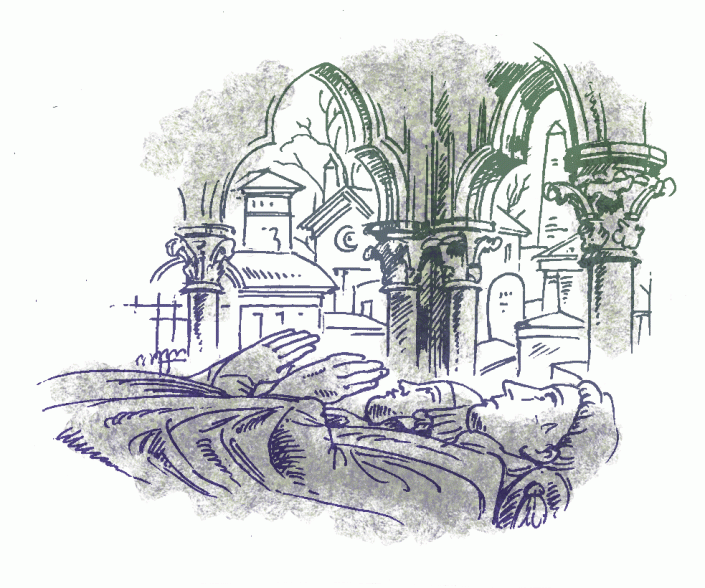 The other day, my most beloved,
one of your men brought me a copy
of the letter you wrote as consolation
for your friend.
From what was written at its head I knew at once
that it was yours, and I began to read it
with a warmth as great as the love
with which I hold its writer in my heart.
I hoped that at least by its words
I could be restored to life,
as if by some image
of the one whose real substance I have lost.
Almost every line, I noticed,
was filled with vinegar and gall,
as it told the sad story
of our entrance into monastic life
and the unending crosses which you my only one,
have always had to bear.
The letter well fulfilled the promise you made
your friend at its beginning, that he would think
his own troubles small or nothing next to yours.
You wrote of your persecution
at the hands of your teachers,
the supreme betrayal
of the mutilation of your body,
and the enmity and hateful malice
of Alberic and Lotulf, who were once
your fellow students.
You wrote of what happened, through their intrigue,
to the glorious book of your
Theology
and to you yourself
when you were condemned as if to prison.
You wrote of the plots of your abbot and false brothers,
the attacks of those spurious apostles
which the same enemies instigated against you,
and the scandal which arose when you gave
the Paraclete its uncustomary name.
And then, when you came to those unbearable assaults
which still are launched against you by that tyrant
and by the worst of all monks you call your sons,
you brought the sad story to an end.
No one, I am sure, could read or hear it without tears,
and my own grief became fresh with every detail,
and it grows greater still as the danger to you
even now is increasing.
We are all driven to despair of your life,
and every day our hearts beat in fear
of some final word of your death.
So, by that Christ who keeps you for his own even now,
we beg of you,
as we are his handmaids and yours,
write to us,
tell us of those storms
in which you find yourself tossed.
We are all you have left: let us share
your grief or your joy.
A community of grief can bring some comfort
to one in need of it, since many shoulders
lighten any burden or even make it
seem to disappear.
If, on the other hand, this storm abates
even just a little, you must write to us quickly
when your letters will bring us more joy.
But whatever it is you write to us about,
it will be no small relief, for in this way
at least you will show you are thinking of us.
Seneca teaches us by his own example
how much joy there is in letters from absent friends,
as he writes to his friend Lucilius:
“I am grateful that you write to me often,
for you show yourself to me in the one way you can.
When I receive a letter from you, we are suddenly together.
If images of absent friends bring joy,
if they refresh our memory and soothe the ache
of absence even with their false and empty solace,
how much more joy is there in a letter,
which carries the true signature of an absent friend?”
And I am grateful to God that here at least
is a way you can grant us your presence,
one which no malice will hinder,
no obstacle impede,
and no negligence—I beg of you—delay.
You have written your friend a long letter of consolation,
addressing his adversities but recounting
your own.
But as you told of them in such detail,
while your mind was on his consolation,
you have worsened our own desolation;
while you were treating his wounds,
you have inflicted new wounds upon us
and have made our old wounds bleed.
I beg of you, heal these wounds you have made, who are so careful
to tend the wounds made by others.
You have done what you ought
for a friend and comrade
and have paid your debt to friendship and comradeship.
But you are bound to us by a greater debt,
for we are not your friends but your most loving friends,
not your comrades but your daughters—yes,
it is right to call us that, or even use
a name more sacred and more sweet
if one can be imagined.
We need no arguments or testimony
to prove the obligation you have toward us:
if men will keep their silence, the facts will speak
for themselves.
You alone, after God, are the founder of this place,
you alone the builder of this oratory,
you alone the architect of this congregation.
Nothing you have built
is on the foundation of another: it is all your creation, everything here.
Before you, this was a wilderness,
an empty range for wild beasts and outlaws;
it knew no human settlement and not a house stood.
Among these lairs of beasts, these dens of outlaws,
where the name of God was never pronounced,
you raised a tabernacle of the Lord
and dedicated a temple of the Holy Spirit
for him to call his own.
Nothing you brought to the task
was from the wealth of kings and princes,
though you could have had so much at your disposal:
it was all to be yours, whatever was done here,
yours alone.
The clerics and students who came flooding here
to learn from you provided all that was needed;
and suddenly, those who were used to living
on the benefices of the Church,
who had learned how to receive offerings
but not how to make them,
who had opened their hands to take
but not to give,
now became prodigal in their gifts
and even pressed them upon you.
Yes, it is yours,
truly yours, this newly planted garden,
whose living shoots are young, still delicate,
and need watering to thrive.
From the nature of women alone the garden is tender
and would not be hardy even if it were not new.
Its cultivation, then, must be more careful,
in the way Saint Paul intended when he wrote:
“I have planted, Apollos has watered,
and God has given the increase.”
He had planted the Corinthians in the faith
by the doctrine he had preached, and his student Apollos
had watered them with his encouragement,
and the grace of God bestowed on them
the increase of their virtues.
But you are tending another’s vine
in a vineyard you have not planted,
and it has turned to bitterness for you,
all your words wasted and vain.
While you lavish your care on another’s vine,
remember what you owe your own.
You try to teach rebels and do not succeed;
you are casting pearls of God’s word before swine.
While you lavish so much on those who defy you,
consider what you owe those who obey.
“Therefore, if you two are not convinced
that no worthier man exists and no finer woman exists
anywhere on earth, then above all else
you will always be seeking that one thing
you think is best—
to have the best of all possible husbands
or the best of all possible wives.”
This notion goes beyond philosophy
and should not be called the pursuit of wisdom
but wisdom itself.
There is a blessed delusion among the married,
a happy fantasy that perfect love
keeps their marital ties intact less through the restraint
of their bodies than through the chastity
of their hearts.
But what is a delusion for other women,
for me is the manifest truth.
What other women only think about their husbands,
I—and the entire world—not only believe
but
know to be true about you,
and in this way my love is far from any delusion.
Has there been a philosopher or even a king
whose renown could equal yours?
Has there been any region of the country,
any city, any town that did not boil
with excitement just to see you?
Has there been a single person
who did not come running
to catch a glimpse as you came into sight,
who did not stretch his neck and strain his eyes
to follow you as you left?
Has there been a woman, married or unmarried,
who did not long for you when you were gone
or lust for you when you were present?
Has there been a great lady or even a queen
who did not envy me the pleasures of my bed?
And two things that belonged to you alone
would win the heart of any woman—
your beautiful voice and your gift for writing songs.
These are not common among philosophers, I know,
but for you they were amusements, a diversion
from your philosophical work.
You left countless songs,
both in the classical meter of love
and in the rhythms of love as well,
that kept your name on everyone’s lips;
and they were of such surpassing sweetness
that their melodies alone would not allow
even the unlettered to forget you.
For this above all, women sighed with love for you.
And since most of the songs told of your love and mine,
in what then seemed an instant my name was sung
in every corner of the country,
and the envy of women was kindled against me.
file:///C:/Users/Paris/Downloads/Abelard%20&%20Heloise_%20The%20Letters%20-%20Abelard,%20Peter%20&%20d’Argenteuil,_4856(1).pdf
Ground Floor (Sully Wing)
Étage 0
Rooms 300 to 348
Louvre Floor Plan (room descriptions)
Department of Greek, Etruscan, and Roman Antiquities:
Classical Greek Art (5th-4th centuries BC)
Department of Near Eastern Antiquities: Iran
Room 11 Iran in the Iron Age (14th–mid-6th century BC) and during the Neo-Elamite dynasties
(Goblet decorated with winged, two-headed monsters, grasping gazelles )
Room 15 Athena gallery (also called the Melpomene gallery)
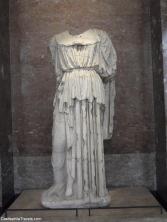
Athena, known as the Ingres Minerva
Room 42 Galerie Campana III
(Rooms 39 – 44)
Room 346 Parthenon Room
(Rooms 39 – 44)
Venus de Milo (Aphrodite)
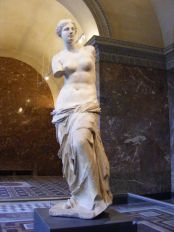
Salle Daru
Daru Room at the Louvre (Room 75)
Large-scale French Neo-Classical French Paintings
Musée du Louvre, Paris
Denon Wing (South Wing of the Louvre)
1st Floor
Room 75 Salle Daru
French paintings in Room 75 (WikiMedia Commons)
Ingres (Jean Auguste Dominique Ingres (1780-1867)
Une Odalisque (depicts an odalisque, or concubine)

David (Jacques-Louis David) (Paris, 1748 – Brussels, 1825)
Coronation of Napoleone
(The Consecration of the Emperor Napoleon and the Coronation of Empress Joséphine on December 2, 1804)
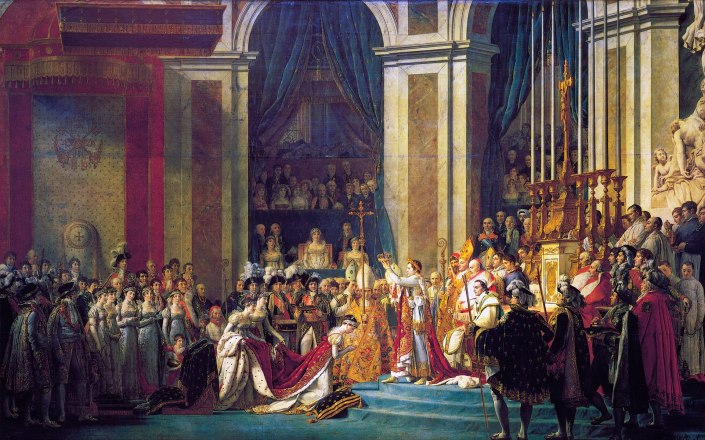
(the second-largest painting at the Louvre)
Georges de La Tour
Georges de La Tour
French Baroque Painter (1593-1652)
Known for Chiaroscuro Caravaggisti scenes
Not to be confused with:
Maurice Quentin de La Tour (1704-1788 Pastels)
Present-day English Actress Frances de la Tour
known for History Boys (Tony Award) and Harry Potter films
Georges de La Tour Room
Room 28
The Louvre, Paris
Sully Wing
2nd Floor
Department of Paintings
French Painting
Le Tricheur – The Cheat with the Ace of Diamonds

Le Tricheur à l’as de carreau (1635)
 Paris for the Holidays